Why Heated Rivalry's Hudson Williams and Connor Storrie Became Queer TV's Biggest Story of 2026
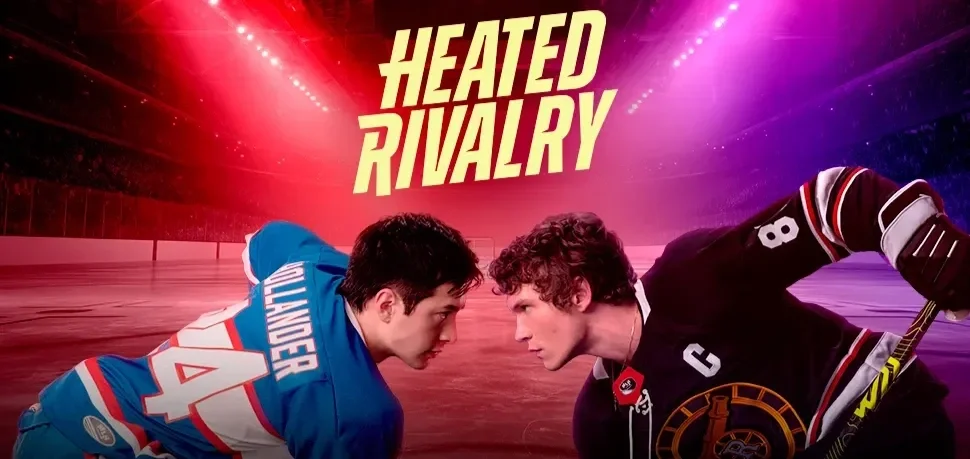
A gay hockey romance novel from 2019 is now producing Olympic torchbearers.
In January, Hudson Williams and Connor Storrie carried the torch for the 2026 Winter Olympics in Feltre, Italy. In February, they reunited on Saturday Night Live, with Storrie hosting. In June, both actors picked up Television Critics Association nominations.
Heated Rivalry, the Crave/HBO Max series they lead, swept 16 awards at the Canadian Screen Awards, including Best Drama Series. The one thing it won't get this year is an Emmy nomination, and not because anyone thinks it isn't good: under Television Academy rules, foreign-produced shows only qualify if a U.S. partner is involved before production starts, and HBO Max only picked up Heated Rivalry for distribution after Crave had already finished making it. Reviewers, for what it's worth, gave it a 96% on Rotten Tomatoes anyway.
That's a lot of mainstream, decidedly non-niche machinery moving around a show about two fictional professional hockey players falling in love. Worth asking why.
From backlist paperback to prestige TV
Heated Rivalry started as the second book in Rachel Reid's Game Changers series, published in 2019. It didn't break out immediately; Reid has said the real turning point came almost a year later, when romance author Cat Sebastian recommended it to her own readers. From there, it became a genuine backlist phenomenon in the gay-romance and BookTok spaces, well before Crave and HBO Max adapted it into a series that premiered in November 2025, following closeted rivals-turned-secret partners Shane Hollander (Williams) and Ilya Rozanov (Storrie) across nearly a decade of hockey seasons.
The show's success did what TV adaptations of romance novels are supposed to do: it sent people back to the books and introduced a new audience to the wider gay sports romance genre that had largely lived on the margins of publishing for years.
You might also like
Why this, and why now
The honest answer is that an M/M sports romance hitting this scale isn't really about hockey. It's what happens when a slow-burn, high-tension romance plot, the kind readers have loved in cishet romance forever, gets applied to two men who spend a decade circling a truth they can't say out loud. Enemies-to-lovers, sports romance, secret relationship: these are some of the most reliable structures in the genre, and Heated Rivalry runs all three at once.
It's also worth naming plainly that a lot of the audience driving this, in the books and now the show, is queer and nonbinary readers who don't see themselves literally represented by two cis gay hockey players and still find something real in the story. The "have to hide who you are inside an institution built on rigid masculinity" arc lands for a lot of people whose own coming-out, or coming-into-gender, looked nothing like professional hockey but felt exactly like that kind of pressure. Representation doesn't have to be a mirror to matter; sometimes it's closer to a very good metaphor.
Enby Meaning
Guides, analysis, and real talk on non-binary life — sent when it's worth sending.
We use Mailchimp. Privacy info.
What this does, and doesn't, mean for the rest of us
It's fair to hold two things at once here.
One: an M/M romance about cisgender men is still, structurally, the safest, most fundable version of "queer content" a network can greenlight, and it's not a coincidence that the breakout queer romance getting Olympic torch relays and SNL slots centres two conventionally masculine gay cismen rather than a trans or nonbinary lead. That's a real gap, not a small one, and it's worth naming rather than pretending the industry has solved queer representation just because one show is doing well.
Two: awards recognition and mainstream ratings for unabashedly queer romance are still a genuinely useful data point for anyone trying to greenlight the next thing. Sixteen Canadian Screen Awards and a TCA nomination are the kind of numbers a studio executive can point to when someone in a pitch meeting asks whether "there's an audience for this." Every project that proves queer stories are profitable, not just tolerated, makes the next pitch, including the ones centring nonbinary and trans leads that haven't gotten their Heated Rivalry moment yet, a slightly easier sell. That's not full circle. It's a step, and it's one worth being genuinely glad about while still asking who gets the next one.
Season two of Heated Rivalry begins production in August, with an April 2027 release planned. Whatever happens with awards eligibility next time around, the audience that got built this year isn't going anywhere.
Enjoyed this read?
Subscribe for more, or explore posts connected to this one below.