Perceive Her: Rebecca Black’s Age of the Exhibitionist Is the Pop Album the Girls, Gays and Theys Have Been Waiting For
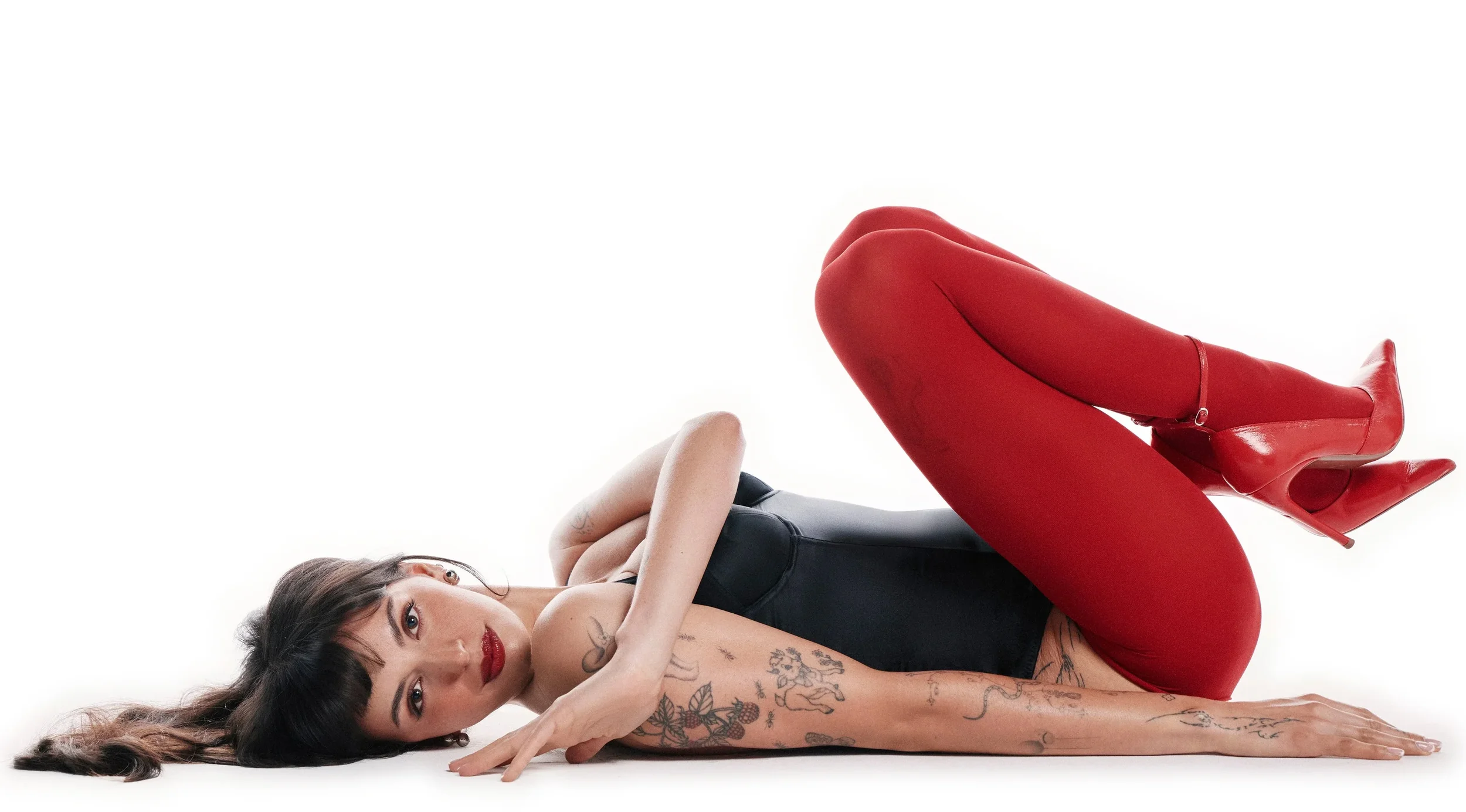
Photo Courtesy of Rebecca Black
Fifteen years after the internet turned a 13-year-old into a punchline, Rebecca Black has made a record about being looked at, and it is one of the best pop albums we’ve heard in a very long time. No skips. No notes. Well, maybe a note (but honestly it’s nitpicky). Across-the-board, no skips!
Let’s set the scene, because the scene matters.
In July 2026, the RIAA certified “Friday” Platinum. A song that was once crowned among the worst ever made, that got a teenage girl death threats serious enough for the Anaheim Police Department to investigate, quietly crossed a million units a decade and a half later.
Now, two months after that certification, Rebecca released Age of the Exhibitionist (2026), a self-released, 12-track sophomore album whose entire thesis is: you were always going to watch me, so I’m going to decide what you see.
That’s the frame. What’s inside it is a filthy, gorgeous, deeply queer dance-pop record made by someone who has finally stopped apologising for taking up space on your screen.
Direct Message to Rebecca: We want to “live, laugh, love, whatever comes next” with you. Please keep taking up space.
If you can't get to the album any other way, Rebecca Black's latest is on Amazon Musicpaid link.
Rebecca Black: From Meme to Main Character
The Tens and Teens (2010-2019)
You know the arc, but it’s worth recapping because the album speaks to it.
Friday - Single (2011)
For most Gen Z, “Friday” was a moment in time. Played in schools, on the radio, splashed across social media.
The song’s video was uploaded to YouTube in February 2011 and received approximately 1,000 views in the first month. The video went viral on March 11, gaining millions of views in a matter of days, becoming the most discussed topic on Twitter, and drawing mostly hate towards Rebecca.
From this moment on, it was hard not to come into contact with the song at least once during its virality.

Rebecca is widely recognised as one of the earliest and most high-profile examples of global, viral internet harassment directed at a minor. While she was not the first to experience online harassment, her circumstance emerged during a time when mainstream media was transitioning from physical media (like print and broadcast) to online platforms. The situation was uniquely visceral, and it wasn’t until a decade later that people began to empathise with her plight. Many have come to understand the risks and dangers of being online, drawing from their own experiences with cyberbullying that became more prevalent in the years following her case.
After “Friday” and the legal mess with ARK Music Factory, Rebecca spent most of the 2010s in YouTube-cover purgatory, with cover songs that narrowly registered, singles that were largely overlooked, and a debut album that never arrived. But importantly, she never gave up.
We were there, waiting for her to step into her own, because we knew she had the potential, but many didn’t expect Rebecca to make it as an artist in the industry. Which, honestly, might have been exactly where she needed to be, even if the process should never have been the means to get there.
RE / BL - EP (2017)
“RE / BL” was the debut extended play (EP) by Rebecca Black. Released in 2017, it was her official comeback project, with the lead single, “The Great Divide”. This project is significant because it showed that, even after facing cyberbullying and hate from the World Wide Web for nearly six years, she reemerged, refusing to be silenced even when everyone wanted her to disappear.

Rebecca shows us through her music today that the takeaway from this era is: if you want it, ignore the haters and chase it, because you certainly won’t get it if you give up. We stand with the girl who had every reason to leave the spotlight and hide in the shadows but never gave up.
The Four: Battle for Stardom
In 2018, Rebecca competed on the reality TV music show The Four: Battle for Stardom. She auditioned with "Bye Bye Bye" by NSYNC and advanced to the next stage with "three blue rings" from all three judges. In subsequent rounds, the audience voted between two performances, leading to Rebecca's elimination.
Despite this, she left a lasting impression beyond just "Friday."
After her appearance, she tweeted: "I am just blown away reading your comments and seeing so much support online," she wrote. “Sending all of my love right back to you. Thank you for hearing me, for seeing me. This is just the beginning.”
So no matter what Rebecca pursues or what music she releases, we aim to honour her name as an inspiration to the girls, gays and theys. So don’t give up because Rebecca doesn’t give up.
You might also like
The Scrolling Twenties (2020-)
Friday (Remix) [feat. 3OH!3, Big Freedia and Dorian Electra] - Single (2021)
The turn came around 2020 and 2021, when she publicly came out as queer on a podcast and dropped the hyperpop “Friday (Remix)” with Dylan Brady, Dorian Electra, and Big Freedia. An arguably cloying, squeaky-freaky version of the original, it was so disorienting that it really paved the way for the direction she aimed for. It was an intentional and markedly uproarious comeback.
Now we argue that the original “Friday” was a masterclass in camp, ahead of its time, by a girl who got defined by the world before she had the words to define herself. But the internet disagreed and largely reviewed it as a very bad song.
“It’s a very bad song, over-the-top autotune, poor singing, silly lyrics and video.”
If you were one of the many who missed the mark on this campy-queer-classic, first, we’re sorry; second, Rebecca wasn’t going to let you make the same mistake twice on the remix.
“Friday (Remix)” feels like Rebecca took every negative review of the original “Friday” and channelled it into a reclamation of self. She played directly into the criticism by sonically reproducing the track to be even more outrageous, with overly over-the-top autotune, sillier-silly lyrics, and a cheesier-cheesy video that outcamped itself. We read this moment as Rebecca making a statement that she heard you, she endured you, and now she’s laughing at/with you, because the very hate that sent death threats aimed at silencing a queer teenage girl with hopes and dreams was redirected into a strong, self-made independent queer woman artist with a career no one believed she’d have.
We love “Friday” and even more so “Friday (Remix),” and we respect this moment in time for her, seeing it as one of the major milestones on the path to the Rebecca we have today.
![Friday (Remix) [feat. 3OH!3, Big Freedia & Dorian Electra] - Single album cover by Rebecca Black](https://m.media-amazon.com/images/I/51rXWj+VqQL._UX716_FMwebp_QL85_.jpg)
Rebecca Black Was Here - EP (2021)
Then, Rebecca released Rebecca Black Was Here, the 2021 EP that made popologists sit up.
Overall, this EP had zero skips, in our opinion. Was it perfect? No, but did it need to be? Also no.
Rebecca was truly starting to play with her sound and lyricism around this time. You could tell she definitely was going to be herself in the music she created, but you could also notice she was still exploring and learning about herself as well. That is an honest, true reflection of self-exploration in your early twenties.

Let Her Burn (2023)
Let Her Burn was her proper debut and earned solid reviews. It was a great project, ahead of its time, and as her first self-released album, it is a true accomplishment for Rebecca. But critic culture wasn’t impressed, and the public stain attached to “Friday” arguably haunted her image; so many major music critics reviewed her through the lens of her past, not her art in the present.
And it has to be said, we are talking about Pitchfork here, which gave this album a 4.4/10. We are offended!
“Rebecca Black reinvents herself as a desperate hyperpop star.”
Calling Rebecca a desperate hyperpop star in 2023, after she literally helped make space for the genre years earlier, is an unnecessary drag and an uninformed opinion. Thankfully, r/popheads agree.
“Call it what it is: terrorism. This is a crime against humanity.”
We couldn’t agree more.
Sometimes Pitchfork needs to put the Pitchforks down; it’s giving crimes against women.
But jokes aside, we understand that sometimes a review is just a review, and art takes time to marinate for some more than others. Let’s not forget “Vroom, Vroom” by Charli XCX got a 4.5 in 2016; if that happened today, r/popheads would be standing with Pitchforks outside of Pitchfork HQ ready to “Let [them] Burn”.

The Boiler Room
After Rebecca launched a tour with dates in the UK, North America, and Canada in support of Let Her Burn (2023), she went on to perform as one of the opening acts for Blackpink, alongside Carpenter, The Rose, Baser, and others at British Summer Time in London.
Her performances and festival runs brought her talent recognition, and on September 14, 2024, she performed a DJ set at Boiler Room, closing with a mashup of "Friday" over Charli XCX's song "360".
Finally, pop culture was truly starting to recognise her as they should.
Salvation - EP (2025)
Salvation, delayed until after the L.A. fires arrived in her hometown, brought the club-kid edge into focus, and by that point she was DJing Boiler Room, opening for Katy Perry on the Lifetimes Tour and spinning the AMAs after-party. Salvation explores the idealisation of female pop artists, along with themes such as queerhood and its place in religion. A standout project from Rebecca, making it clear she doesn’t need you to save [her], as [she] already saved [her]self.
Salvation changed our lives, and it will stay streaming alongside Age of the Exhibitionist for us. It was a standout project, and one that went widely unrecognised by the mainstream while her true fanbase was being solidified.
Pitchfork didn't review this project, and we appreciate that.

Enter the “Age of the Exhibitionist” (2026)
The woman who released Age of the Exhibitionist on September 4, 2026, isn't making a comeback.
Rebecca Black is an established queer pop artist with a rabid fanbase, a DJ career and a pretty clear sense of who she's making music for. When she told NME last year that "gay is a way of life," that wasn't a marketing line. It's the operating system of this record.
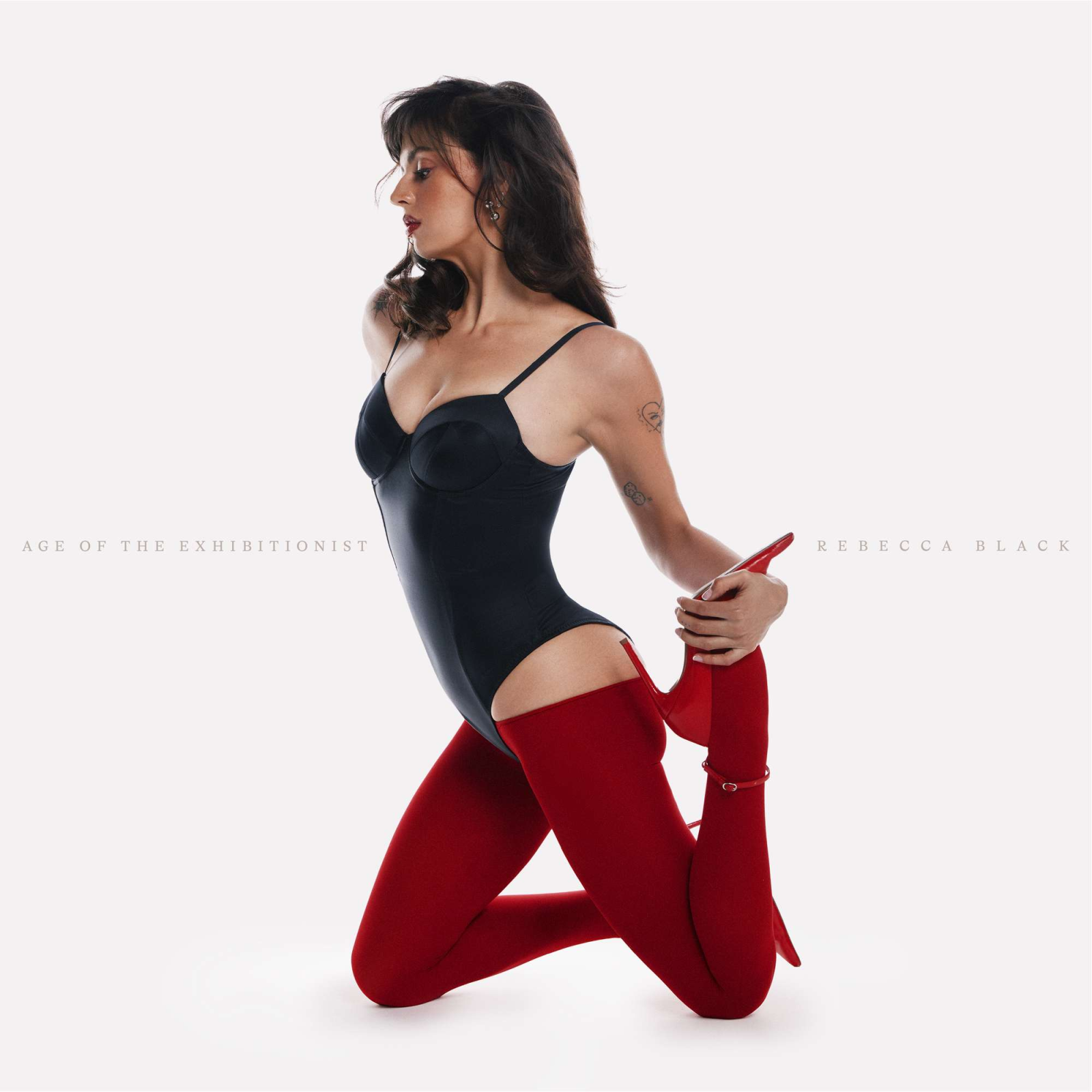
Age of the Exhibitionist is the second studio album by Rebecca Black. It was released on September 4, 2026.
A tour to promote the album titled “Exhibitionism on Tour” was announced in July 2026, featuring shows in the US and Canada.
Tracklist: 1. "Anaheim Star“, 2. "Hot Wet Delirious", 3. "Exhibitionism”, 4. "Corsetry”, 5. "Miss Delicious", 6. "Pistol”, "Backstage Baby Interlude”, 8. "Michael.”, 9. "Visions Again”, 10. "Washchesalon”, 11. "Metamorphia”, 12. "Speakerphone".
Dare we say queer icon, fully made, no longer in the making.
If you can't get to the album any other way, Rebecca Black's latest is on Amazon Musicpaid link.
The Concept: Being Perceived, On Purpose
The title track gets to it fastest. "Exhibitionism" is built on gallery imagery: velvet ropes, gold frames, wide-open windows and neighbours hoping for a glimpse. But the trick of the song is that the exhibitionist here isn't performing for pleasure so much as for recognition.
Rebecca has described the track as tapping into a carnal need to be understood, and it's that word, understood, that rewires the whole concept. The bridge asks to be seen at her ugliest, on her knees, and lists her feminine touch right next to her masculinity as the exhibits on display.
For a gender-diverse listener, that's the moment the album holds up the mirror. Every enby knows the difference between being looked at and being seen. This song is about begging for the second one while dressing it up as the first.
Sonically, it's also where the album’s production philosophy lands. Marcus Andersson, Nightfeelings and Chris Lyon build something plush and hypnotic, with a post-chorus that repeats the title until it dissolves into a chant. It's pop as incantation.

Filth as Community: “Waschesalon”
If "Exhibitionism" is the thesis, "Waschesalon" is the party where the thesis gets sweaty. The origin story alone deserves its own plaque.
On tour in Europe last year, Rebecca and her small, mostly queer crew of dancers and creatives spent their off days doing laundry together, running groceries, and hitting clubs. Sitting in a German laundromat, they invented a fictional underground queer club hidden inside one, and joked about it for months. Nearly a year later, stuck on a different song in London, she pulled the idea back out and, in her own words, made it "really gross and dirty."
She did.
The song opens with a shopping list of adjectives (nasty, dirty, grotesque) and a deranged pun on the "live, laugh, love" of it all, then throws you onto a floor where a DJ called Pushbutton is melting faces and the girls go there to get off.
Verse two is the most explicitly sapphic writing of Rebecca's career, and it ends with a gag about making a million off her so-called mediocrity that is, frankly, the funniest thing a former meme has ever put on a record. Marcus Andersson and Starsmith's production crunches like the bass is “chew(ing) on [your] waist like bubblegum” (reminiscent of sugar water, cyanide).
But what makes it more than a banger is the bit that survived from the laundromat: the idea that queer people can build this place anywhere they are. A laundromat in Germany. A group chat. A rented flat in London with a Bluetooth speaker.
Chappell Roan gave us the Pink Pony Club as a mythologised West Hollywood; Rebecca Black gives us a wash house, which is somehow more honest. Our sanctuaries have always been a bit grubby. That's the point.
Enby Meaning
Guides, analysis, and real talk on non-binary life — sent when it's worth sending.
We use Mailchimp. Privacy info.
The Lover with the Gun: “Pistol” and Its Echo
"Pistol" is the album's beating heart, and it's a love song that reads like a crime scene. The chorus casts a girlfriend as the weapon, one who never misses, with the narrator spun like a disco ball at half past one downtown and cigarette smoke curling out of her lover's mouth. There's a pre-chorus that calls her mama to say she can't come home, and a second verse where she's dropped her last name entirely. Whether or not you read that as literal, it's the queer plot in miniature: the family you leave, the name you shed, the person who ruins you in the best way.
Oscar Scheller and Nightfeelings give it a sleazy, swinging groove that lives somewhere between late-2000s bloghouse and the kind of Britney deep cut you'd play at 2 am. And then, "Backstage Baby Interlude" does something clever: it revisits the pistol image from the other side.
Now Rebecca is the popstar bringing a lover backstage, showing her off under the lights, and by the outro she's declared herself the one holding the gun. Power traded across a tracklist. That's sequencing with intent, and it's the kind of detail that rewards front-to-back listening, which, given how we've complained on this site about albums built for the shuffle button, is worth celebrating.
“Corsetry”: The One That Hurts
Every great pop album needs the song that makes you sit down on the floor of the club bathroom, and "Corsetry" is it. Produced by grandma (yes, that's the producer's name) and co-written with Leland and Jesse Saint John, it's a song about restriction, physical and emotional. The images are all about pressure: lungs tied down, tears that won't come, skin pulled tight, a face that refuses to give anything away. A long-distance partner calls to say the space between them keeps her up at night, and the narrator's body keeps dancing while her mind won't file the feeling anywhere.
Then there's the second verse, where she's marched down an aisle, sucking it in, playing the perfect girl at home, admitting she'd rather be watched. A whole gendered history is packed into that garment, and Rebecca uses it to talk about the labour of holding yourself together for an audience.
For those of us who spent years binding, tucking, contouring or otherwise editing our bodies into a shape someone else could handle, this one lands somewhere behind the ribs. That she puts it fourth, right after the title track and before the album's most fun stretch, is a flex. She knows you need to feel the pinch before you're allowed to dance.
“Hot Wet Delirious”: The Single That Earned Its Title
Of the three singles, “Hot Wet Delirious” is the one that ate. Released alongside the album announcement in July, with a Hannah De Vries video co-directed by Rebecca and choreography from Richy Jackson, it's a seduction song about a connection so charged that everyone in the room can hear it.
The chorus keeps daring the other person to make a move while insisting it isn't that serious; the verses admit it very much is. Rebecca has said she wrote it straight off tour, about feeling so "energetically mobilized" by someone that she was turning into a person she didn't recognise. Apple Music's editorial note hears Britney, Brandy and bloghouse in it, and honestly, that's the right playlist.
What's queer about it isn't only that the object of desire is a woman. It's the shape of the desire: illicit, witnessed, half-denied, thrilling precisely because it's not allowed. Anyone who has ever fallen for someone across a table full of people who'd have opinions about it knows this exact chord progression in their chest.
The Rest of the Floor
The remaining tracks are far from filler.
"Anaheim Star," the opener, is Rebecca's first real Orange County origin myth, complete with a midnight train downtown and the party photographer of the bloghouse era name-checked as the person she's dancing for. It's a Fergie-shaped banger for a new decade.
"Miss Delicious" introduces the alter ego the whole tour is named after (Exhibitionism on Tour — Rebecca Black as Miss Delicious), and Rebecca's description of her is worth quoting: a version of herself she only meets on stage or at the perfect hour in the club, fully in command. She adds that we all have one, and that living as her full-time seems exhausting. Relatable to every enby who has a going-out self and a Sunday self.
"Michael." is the sketch that became a song.
In the studio, distracted by Lady Gaga lore and Reddit threads about her fiancé Michael Polansky, someone said the name out loud, kept saying it until it lost meaning, and it became a stand-in for the safe choice, the obvious boyfriend, the guy a girl is supposed to want.
The song is Rebecca at a bar, making the case that she could do the job better. She's been clear that it isn't about Polansky himself, and it isn't. It's about the very gay experience of looking at someone's perfectly fine boyfriend and thinking: I could fix that.
"Visions Again" is the come-down, a mid-tempo about driving out of Anaheim on the 5 and getting everything you wanted, only to find it doesn't feel like you imagined.
"Metamorphia" is a fantasy club with a bouncer and a Dante reference.
"Speakerphone" closes the album where the era began: guns in the air, heart on Speakerphone, a line about wanting to be perceived, and the album's sharpest lyric about the price of visibility, where someone else gets cake for dinner, and she gets the guillotine. It's a fitting bookend for an artist who has spent her whole adult life being the content.
Circling back to her intentional sequencing, Rebecca made this album for front-to-back listening. Put the album on repeat and listen to how Speakerphone bleeds into Anaheim Star; it’s smooth, and the journey through the tracklist deserves a round two.
You might also like
The Note (There's One)
This is a near-perfect record, so let's be precise about the "near." And like we said at the beginning, you can honestly call us nitpicky because no notes are really needed. We are just a media company. Age of the Exhibitionist is the art. And Rebecca Black is the star.
Remember, no skips.
At 12 tracks with an interlude, the album is over faster than you'd like. That's a compliment with a sting.
We are thankful that, in the age of TikTok and artists releasing new albums under 25 minutes and generally lacking a concept, Rebecca’s album clocks in at 37 minutes and 58 seconds. It’s conceptual and feels like an album. But at under 40 minutes, it leaves you wanting a little more.
You will immediately play it again.
Why Rebecca Black's “Age of the Exhibitionist” Matters for the Girls, Gays and Theys
Pop in 2026 is full of women performing vulnerability, and many do it beautifully. What Rebecca Black does differently is refuse the confessional frame. She isn't asking you to feel sorry for the girl from "Friday." She's asking you to look at the woman who survived it, who is queer and loud and horny and funny, and who has built a small, sweaty world where the girls go to get clean and get dirty in the same building.
For an audience who has spent their whole lives being perceived without consent, misgendered in the comments, screenshotted, discoursed about, there is something quietly radical about an artist choosing exhibitionism as a stance rather than having it forced on her. The album's title is a reclamation in the same way Lorde reclaimed "virgin" last year: a word loaded with shame, turned into a manifesto. Being watched is not the same as being seen. Age of the Exhibitionist is a record about demanding the second while owning the first.
Rebecca got the life she always wanted. She's showing it off. And we are absolutely, deliriously, here for it.
Rating: ⭐️⭐️⭐️⭐️⭐️ (5/5 stars)
Artwork: Rebecca Black's 'Age of the Exhibitionist' (2026).
Album: Age of the Exhibitionist by Rebecca Black (2026). Self-released.
Age of the Exhibitionist is a filthy, funny, emotionally sharp dance-pop record that turns fifteen years of being watched into a manifesto about being seen. It's cohesive from front to back, unapologetically queer, and produced with real teeth. The former meme is now one of the most interesting pop artists working, and this album proves it.
Fave Tracks: Exhibitionism, Waschesalon, Pistol, Corsetry, Hot Wet Delirious
Best For: Pre-drinks with the group chat, a laundromat at 1 am, texting the girl who has a Michael, and reminding yourself that being perceived is only a problem when you didn't choose it
Queer Core Takeaway: Visibility is a stance, not a sentence. We all have a Miss Delicious and a Sunday self, and both of them deserve a dance floor. Build your Waschesalon wherever you are.
Which track has you in a chokehold? Sound off in the comments and tell us where your Waschesalon is.
Want more queer music moments, pop culture analysis and glittering hot takes? Subscribe to Enby Meaning for the next drop.
Enjoyed this read?
Subscribe for more, or explore posts connected to this one below.